


Chandigarh: A TGT Science (Non-Medical) teacher at Government Model High School (GMHS), Maloya Colony, has emerged as an example of how innovation, creativity and community participation can transform learning opportunities for students in government schools. With more than 16 years of service at the school, the educator has developed a range of experiential, low-cost and activity-based learning initiatives aligned with the vision of the National Education Policy (NEP) 2020.
Located in a socio-economically vulnerable settlement on the periphery of Chandigarh, GMHS Maloya Colony has used locally available and discarded materials to create innovative learning spaces and scientific models. Several of these initiatives have subsequently been scaled across other government schools in the city.
From Scrap Materials to a 360-Degree Science Experience
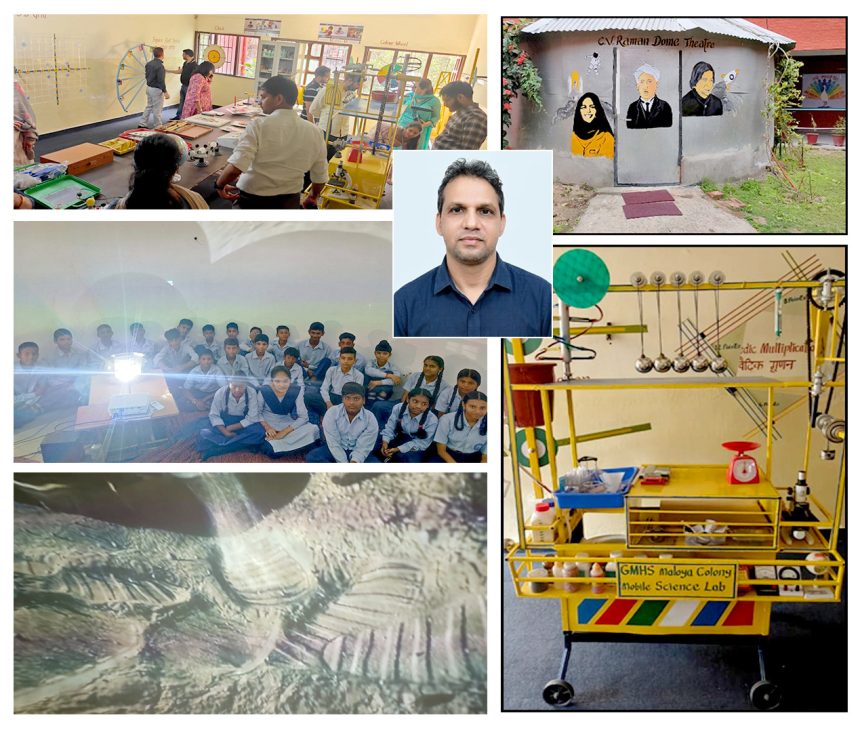
One of the prominent innovations is the C.V. Raman Dome Theatre, conceptualised and constructed within the school using discarded materials such as tin sheets, thermocol and paper scrap. The immersive dome features a curved projection setup that provides students with a 360-degree learning experience, taking them on virtual journeys through space and biological systems.
The facility can accommodate around 25–30 students in a session. Recognising the potential of the model, Samagra Shiksha Chandigarh subsequently scaled the concept to six additional government schools.
The school has also developed a Mobile Science Lab or Lab-on-Cart, made using scrap metal and discarded benches. The portable laboratory enables students to conduct practical activities directly in classrooms, with equipment including microscopes, circuit boards and chemical reagents.
Complementing this initiative is a Child-Centric Lab, featuring tactile and interactive models such as the Square Root Spiral, Abacus and Integer Number Line. These installations help connect mathematical concepts with science and foundational learning.
Indigenous Science Park Brings Concepts to Life
Another major initiative is the Indigenous Science and Knowledge Park, an outdoor learning space featuring student-friendly working models. The park includes a low-cost weather station with a DIY rain gauge, wind vane and aneroid barometer.
Other hands-on models include a See-Saw Water Pump, Solar Water Heater, Hamster Energy Wheel, Sympathetic Swing and Archimedes Screw. The initiative aims to encourage students to understand scientific principles through observation, experimentation and direct interaction.
Contribution to Digital and National-Level Learning
The teacher’s contribution extends beyond the school campus. More than 149 digital learning modules have been contributed to the VidyaDaan initiative on DIKSHA. Video lessons have also been recorded for PM e-Vidya’s Kishor Manch.
The educator has authored the activity book Explore Science Behind This, co-developed the weekly cartoon magazine HARSHIT, and contributed to the integration of QR codes into NCERT textbooks, supporting technology-enabled learning.
Students Gain National and International Exposure
The school’s experiential approach has also translated into significant opportunities for its students.
Student Saneha, an INSPIRE Awardee, represented India through the Sakura Science High School Program in Japan in 2025, following mentorship from the teacher.
Another student, Pawan Kumar, a State Awardee and participant in the first National INSPIRE Scheme, received an opportunity to interact with the Honourable President of India at Rashtrapati Bhavan.
Student Abhishek Mehto was selected among 108 young scientists from across the country for the ISRO Young Scientist Programme (YUVIKA) in Ahmedabad.
Overall, students mentored through the initiatives have received more than 20 national-level recognitions, including awards and selections associated with RBVP, INSPIRE, JIGNYASA and the Northern India Science Fair.
GMHS Maloya Colony has also secured six State-Level Overall Best School Trophies, in 2014, 2015, 2017, 2018, 2021 and 2022.
Literacy and Community Engagement
The educator has also contributed to community literacy initiatives as Chandigarh Coordinator for the ULLAS National Literacy Scheme, helping establish Samajik Chetna Kendras and supporting community-based literacy drives.
To provide additional support to students from economically disadvantaged backgrounds, the Mother Teresa Maloya School Help-Group (MTMS) was established. The initiative has helped mobilise assistance for students requiring support for medical expenses and higher education.
Community partnerships have also helped the school secure STEM kits, including support from LIFE Lab and the Raman Science Foundation, stationery kits for around 400 students through LIC, and healthcare camps.
Building Capacity Beyond the School
The educator has additionally served as a Master Trainer for initiatives including NISHTHA, PISA Science Literacy, Rashtriya Avishkar Abhiyan (RAA), ICT in Education and the PHOENIX Project across Chandigarh and neighbouring states.
The work at GMHS Maloya Colony demonstrates how innovation does not always require expensive infrastructure. By converting discarded materials into learning resources, bringing experiments into classrooms and involving students directly in scientific exploration, the school has created a model of education focused on curiosity, experimentation and practical learning.
The initiatives reflect the broader objective of NEP 2020—moving beyond rote learning towards experiential, competency-based and joyful education—while demonstrating how grassroots innovations in a government school can potentially be adapted and scaled for wider impact.