



Mumbai | Updated: July 5, 2026
India’s largest tunnel boring machine has started excavation work from the Vikhroli shaft, marking a major milestone in the Mumbai-Ahmedabad Bullet Train Project.
The machine began its tunneling work on Sunday for the underground section of the high-speed rail corridor.
Of the total 21-km underground tunnel section, a 16-km stretch between Sawli in Ghansoli and Bandra Kurla Complex in Mumbai will be constructed using tunnel boring machines.
The remaining 5 km section has already been completed using the New Austrian Tunnelling Method.
The tunnel boring machine launched from Vikhroli will construct a 6-km-long single-tube tunnel. This tunnel has been designed to accommodate both up and down tracks of the high-speed rail corridor.
During the excavation, the machine will tunnel beneath multi-story buildings, major roads, the Mithi River, and other critical infrastructure.
Officials said the work requires high precision and continuous monitoring due to the sensitive urban surroundings.
The tunnel boring machine is the largest ever deployed for railway tunnel construction in India.
It has a 13.6-meter-diameter cutterhead, which is nearly equal to the height of a four-story building. The machine weighs around 3,100 tonnes and is 96 meters long.
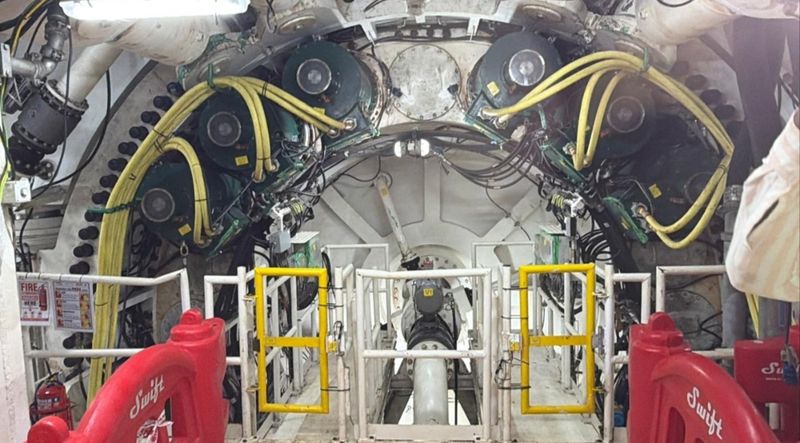
The machine includes key components such as the cutter wheel, main bearing, jaw crusher, erector, main shield, and tail shield. It also has four specialized gantries to support tunneling operations.
The cutterhead can rotate at up to four revolutions per minute.
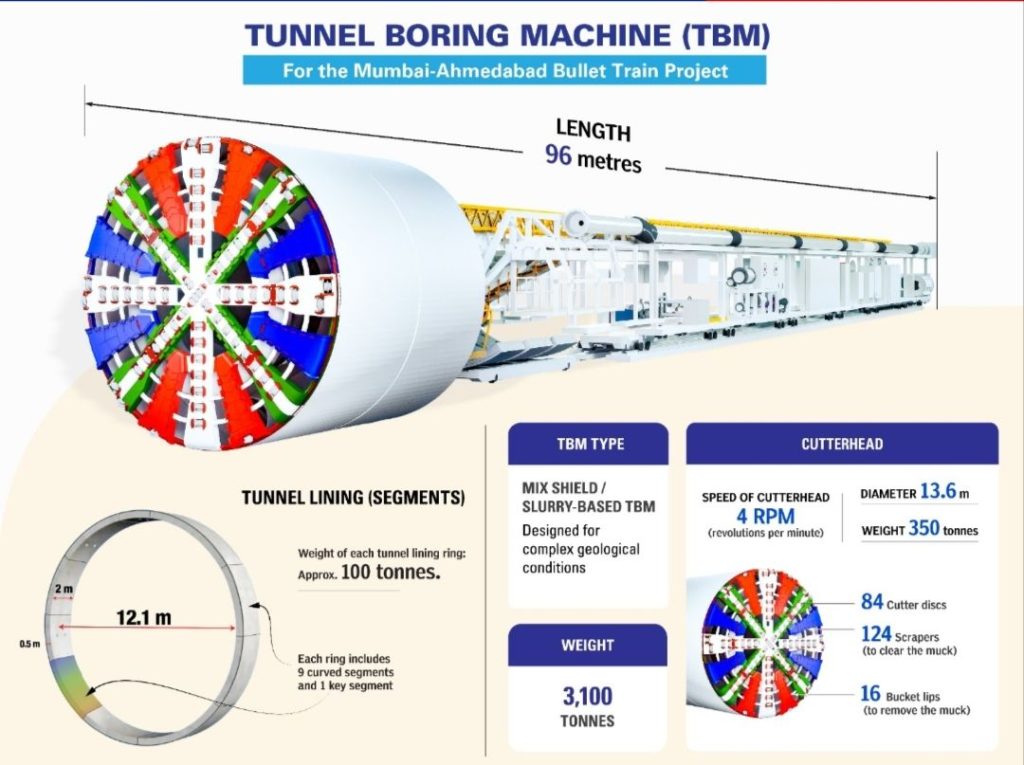
The machine is a Mixshield TBM, an advanced slurry-type tunneling system designed for large-diameter excavation in mixed geological conditions and areas with high groundwater pressure.
To launch the machine, a 56-meter-deep shaft was constructed at Vikhroli. The shaft is nearly equal to a 20-story building below ground level.
A real-time monitoring system has been installed to ensure safe tunneling and protect nearby structures.
The tunnel section being excavated with tunnel boring machines is being built as a fully waterproof structure.
Continuous monitoring systems have also been installed to track structural performance, groundwater behavior, and overall construction safety.
The development is being seen as a key milestone for the Mumbai-Ahmedabad High-Speed Rail Project.
According to Railway Minister Ashwini Vaishnaw, operations on the Surat-Bilimora section of the bullet train project are expected to begin in August 2027.